

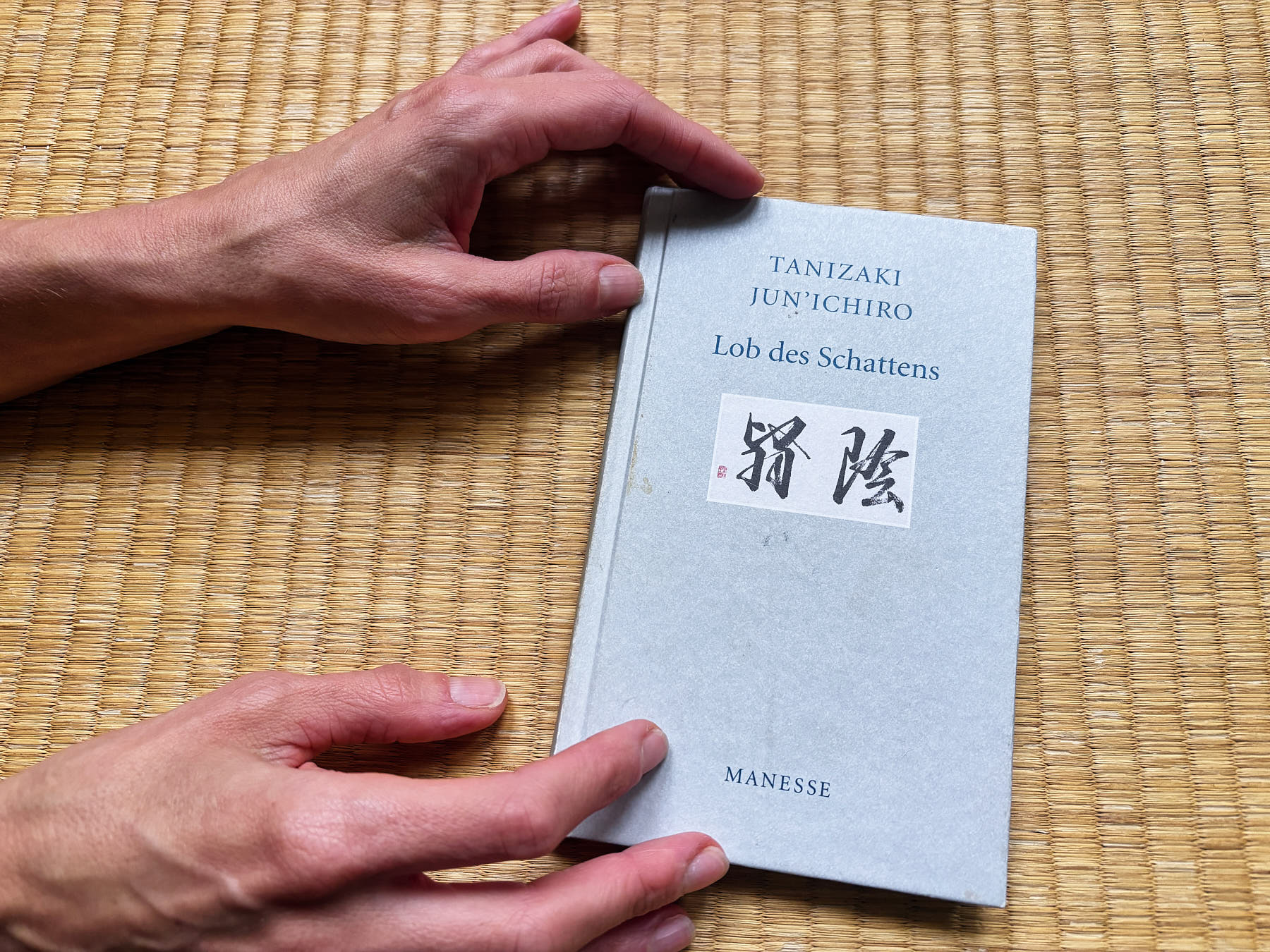
When you are into Kinbaku, this is one of the books you should read.
For me, one of the most influential and educating texts for approaching the subtleness of Japanese aesthetics — and therefore culture — is a small book from 1933: Jun’ichirō Tanizaki’s In Praise of Shadows. I encountered this book many years before Kinbaku found me. It opened my eyes to the beauty that lies in the non-obvious, in the dark, in the shadow.
Many texts attempt to explain concepts such as wabi-sabi or other ideas of Japanese aesthetics. For me, this book stands apart. Perhaps because it is written by a poet. It speaks to the heart of the reader, not to the analytical mind.
The title alone says a lot. Who in the West would praise shadows? We praise light, clarity, sharp contrast — black or white. Tanizaki does the opposite: he praises haziness, semi-transparency, the muted glow of jade, the dim light falling through shōji paper walls in a traditional Japanese house.
Tanizaki Jun’ichirō, a contemporary of Sei Itō, is considered one of the major writers of modern Japanese literature. Some of his work engages openly with sexuality and destructive erotic obsessions. Again and again, his writing circles around the question of cultural identity under the pressure of Western technology and influence.
If you are interested in Kinbaku, read this book. It will not make you understand. But perhaps you will feel what I felt: a quiet kind of magic that emerges when light and sound are dimmed — and the shadows come alive.

Bibliographic information:
Tanizaki, Jun’ichirō. In Praise of Shadows (In’ei Raisan). Japan: first published 1933.
English translation (classic edition)
Tanizaki, Jun’ichirō. In Praise of Shadows. Translated by Thomas J. Harper and Edward G. Seidensticker, foreword by Charles Moore, Leete’s Island Books, 1977. ISBN 978-0-918172-02-0. You can still find this edition available through niche booksellers and library collections.
English edition (Vintage Classics)
Tanizaki, Jun’ichirō. In Praise of Shadows. Vintage Classics, 2001 (reprinted edition). ISBN 978-0-09-928357-7 — common edition in bookstores.
New illustrated or translated editions have been released in recent years. You can view details from one publisher here. (On the picture you see the German edition).