

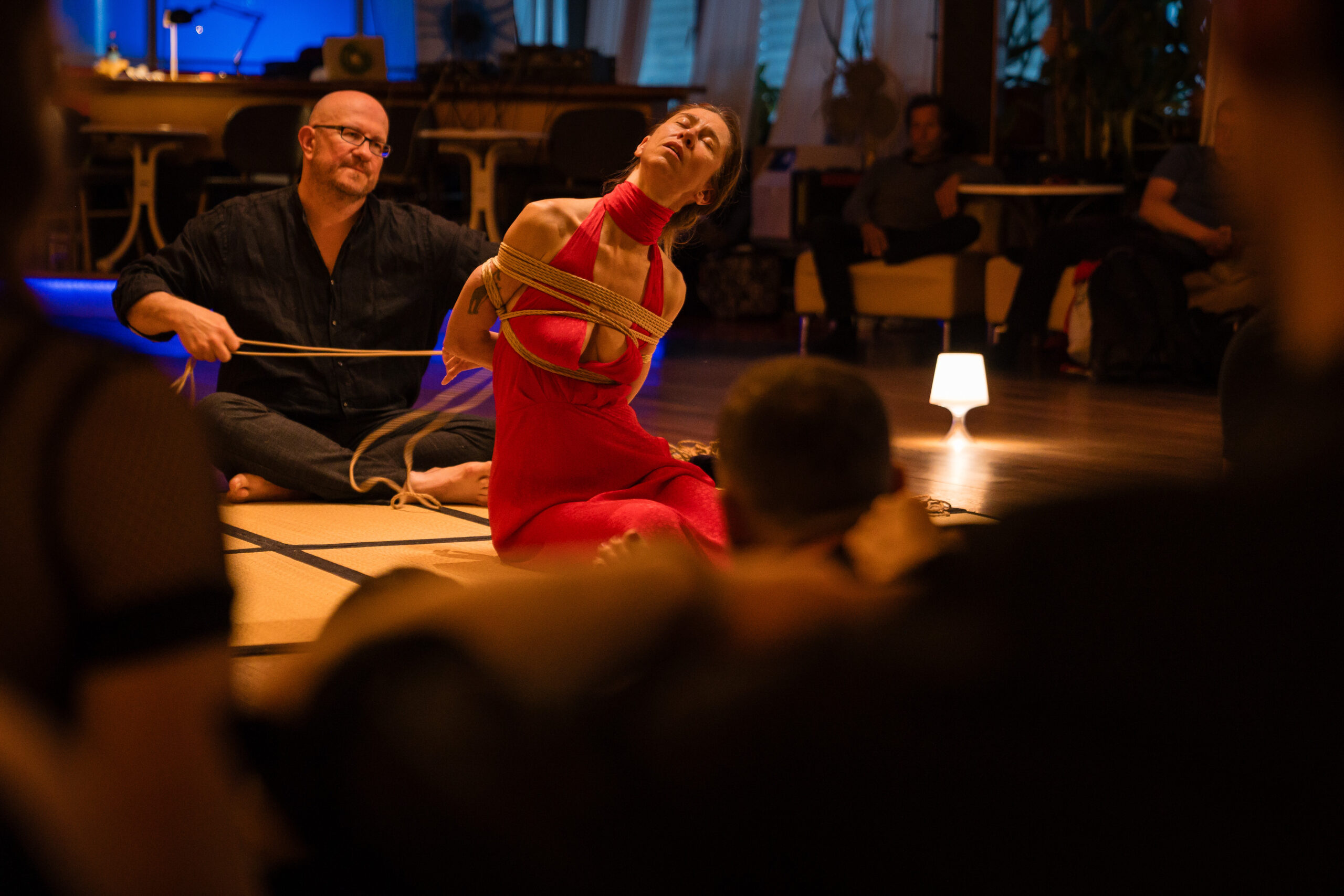
My partner is teaching his students to develop a tying process focusing on the present moment, rather than fixed shapes. He wrote about it HERE
Observing tying couples over years, I have a vague feeling that many people hold the assumption that first they learn the technique and then they are better equipped to make decisions in the present moment, e.g. they feel more secure to venture into spontaneous play (read: they know “where to pull next”). So, first come technical skills, and then plug in the fun.
These are not sequential steps but different capacities that need to be (or can be?) grown over time, in parallel. One is technical capability, which is very much necessary, no doubt here, and the other is capability to tune into the moment. Which mainly is about holding the insecurity of not knowing next, seeking the decision in your heart (or other body parts also work 😉 and not allowing yourself to fall into the safe choice of doing the “next reasonable” thing.
I really mean it. The mastership does not remove the insecurity of stepping into the unknown, for insecurity is an essential part of stepping into the unknown. And I see these two capacities as not dependent on each other. I saw very experienced and obviously skilled people tying the most formal thing. I saw total beginners rocking it, without knowing how to finish one knot.
As my partner put it:
Insecurity is something you will always feel when you try to tie “in the moment“ Alexander Ma.
There is a wonderful German word, Übersprungshandlung. It describes an action that appears unrelated to the situation at hand but serves as a way of coping with internal tension, uncertainty, conflict, or strong emotions. Instead of responding directly to what is happening, a person unconsciously shifts their energy into another, often harmless or habitual, activity.
This is where we go, doing the next reasonable thing, the habitual thing, or the safe thing that “works”, when there is no tolerance to sit with the internal tension and uncertainty. It’s not satisfying for anyone, and your rope bottom will feel it, too.
As a bottom, I can tell you this.
The moments I have felt most seen were rarely the most technically impressive ones. They were often the quiet pauses. The moments when nothing happened. When my partner was not already reaching for the next rope or the next idea, but was simply with me. Looking. Listening. Inquiring.
I recognize it’s a great deal of learning to get to the place of spontaneity. In no way is this a critique, especially for someone who is learning. It’s a gentle reminder that technical skill alone does not create presence. Different capacities need to be cultivated alongside technique, expanding our ability to tune in the moment, rest in not knowing, and create a meaningful experience for both of you.
That means for the riggers, this is your work.
Slow down. And I don’t mean tying slowly. I mean, dare to pause your tying. Embrace internal tension and insecurity. Dare to do nothing, other than just take a breath. I promise, they are not bored:) Let the feelings surface - in the person in your ropes, but also in yourself.
Do less. Dare to tie below your technical capability. Get more humble about how much you can accomplish in one session. Hold back on grand gestures and offer more space for your partner to shine.
Observe more. What are you looking at, actually, when you are looking? I invite you to look as an open inquiry into the person in your ropes. How are they doing, just coping, enjoying, angry, flirting, and asking for more? What is their invitation, their offering? Do they challenge you? Are they hidden? Did you get an impulse…? Now, it’s time to grab another rope. But not before.
The next movement must not come from your memory, but from the person in front of you.
That also means for the bottoms, they need to show up in the process. When you really want to be seen and appreciated as you are, when spontaneous play is really what you are looking for, you need to bring in your own presence, invitation, and a lot of permission for your partner. They need to feel safe enough not to “play it safe”, not to do “the next reasonable” thing.
I started with Mut nichts zu machen ("the courage to do nothing"), but the deeper point isn't that nothing happens. It's that by having the courage to do nothing for a moment, we make space for something authentic to emerge.