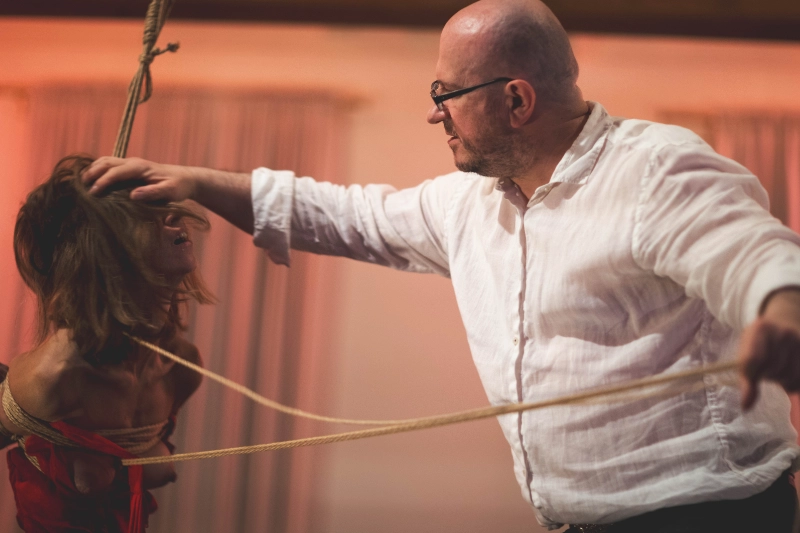
The Gote is the most basic pattern of Japanese rope bondage, the most common, and the most misunderstood. I refer to “gote” as the position of arms on the back tied in some way with the wraps around the chest. It is a typical „prisoner“ tie.
There was much written on it before – on the right name (gote or takatekote?), the right pattern, the right tension and so forth. I will leave all this to people more experienced than me. I like to ponder about the process of tying a Gote. I will write about how we initiate the whole thing. What is the mindset of both partners? In which physical – and therefore mental – position they put themselves, even before touching the rope?
In my observation, there are three ways to tie a Gote:
- The Hojo-Jiu-Jitsu way
- The cooperative way
- The polarity way
THE HOJO-JIU-JITSU WAY
Some modern Kinbaku techniques are derived from Hojo-Jutsu, an ancient Japanese martial art. Therefore, as the Gote is a prisoner tie, it makes some sense to „take down“ the person in rope, and wrestle the arms on the back. This can even be fun – like starting the scene with a playfight. This also establishes who is in power and sets the right frame for a dominance game, doesn’t it?
I did this arm movement many times in my past – I started to study Japanese martial arts actually at the age of 14. We learned how to wrestle the arms of a resisting person on their back – the same technique that police are using.
In my opinion, this technique is not „conservative“ for the shoulders and joints of the person taken down. Actually it is meant to put stress on exactly these parts of the body to control a person resisting. (Think of a drunk big guy who is trying to start a fight). In my evaluation this is exactly the same as for the original Hojo-Ties. As they were applied to captives, suspects or sentenced criminals, they aimed on all these points: nerves, joints, blood and air supply restriction we try to avoid these days, when tying lovers, not criminals.
Even if one takes it a notch softer, working with „Ki“ and not the physical force (as in more philosophical oriented Aikido instead of self-defence oriented Jiu-Jitsu) it takes a great capability to apply this technique in a safe, conservative way. I personally know maybe 2.5 people in the rope scene who I would trust to execute a proper – conservative and safe – arm lock into Gote position to an inexperienced person they want to tie…
In Aikido, we learn to let go under stress, to relax into uncomfortable positions – a process that is counterintuitive and takes time. Our natural reaction when someone attacks us is tensing up muscles, raising shoulders, putting our head down: we build an armour. Is this the right starting point for tying a good Gote? I don’t know… I think it depends on what you want to do with it. I think when you want to keep doing play fight, primal play, role play full of adrenaline – then maybe that’s the right energy. But it is probably not a good base to tie a stable safe Gote as a basis for a long suspension.
THE COOPERATIVE WAY
The most common way to execute rope bondage in Europe these days is to make it a mutual exercise. The bondage itself, the positions, the actions (and the non-actions) are all negotiated. In this mutuality, the person tied takes a lot of responsibility for their own well being. In the „Wheel of Consent“ model by Betty Martin, this should actually be a Giving-Receiving dynamic. The person tied expresses a wish how they like to be tied and the person tying fulfils that wish, within their own limits, of course. But in reality, many people are not so clear about it, so one can observe very often the person in ropes expresses their wish to surrender and then still keeps a lot of control.
In tying the Gote, the control is often expressed in an active movement into the Gote position. In some places, one can observe models actively folding their arms on the back, even when the rigger actually is about to perform the job.
For the joints and muscles as well as the somatic system in general that’s of course much more conservative than a „wrestling attack“. There is much less „shock“ and therefore much less tendency to build an armour. Hence, there is still a lot of muscle tension – just as there is an active movement, performed by the person tied. In our point of view, this active muscle work is an expression of the control the person in ropes takes (or keeps). This control is good, when you are in an „active bottoming“ mood. Hence, it will be more difficult to surrender into the ropes in this mindset and this somatic posture.
THE POLARITY WAY
What we believe in and apply in our Kinbaku is that both partners have an active role in the scene – but on the opposite sides of a polar spectrum. The person tied wants to get tied – they want to surrender to the ropes, the rigger, the scene. The rigger wants to tie (obviously!), but foremost, they want to take control. In the „Wheel of Consent“ model that is a Taking-Surrendering dynamic. It is all about an intention and a mindset.
In this mindset, the rigger is not in a martial art mindset. It feels insane to me, to „take down“ my partner before tying her. She wants to surrender, she wants to get tied – it is her wilful act. Actually, that’s her part of taking responsibility for herself: deciding when and by who she is being tied and within which limits… When she decides to make me this „present“, I do not need to establish my dominance forcefully. I already have it, when I take the present.
In one workshop I gave recently someone asked how I deal with bratty models. The answer is: I don’t do Kinbaku with them. I might enjoy playing with her. Maybe I will have a play fight. Maybe I just wait… But actually, I cannot tie in my framework, in my usual mindset – at least not conservative, not safely. So, when someone expects me to demonstrate my physical capability to take-over, I can probably do, but then I will most likely do nothing of what I usually tie…
Therefore, when it comes to Gote, the bottom makes an offering. They kneel down in seiza. They wait for me until I am ready to tie. And then they start to hand over their body to my will – without active work.
As everything else, it is a process. It is somehow even „active“ work – but active inner work, not active muscle tension and arm movement.
I need to position the arms, whilst my model is starting to relax, to trust, to feel. The more I feel her trust, the more I can dare to take. And this all starts with the Gote – or even before.
In the „polarity“ way me, the rigger, has to do all the work. This gives me control. When we establish the basis – the Gote – with the first rope tied, we can build on it, rope by rope. We both don’t know where it will lead to – that’s the magic…
All three ways of tying a Gote have their own beauty. No one is better than another – in absolute terms.
It is just about finding an expression to your intention – to what you want to do.