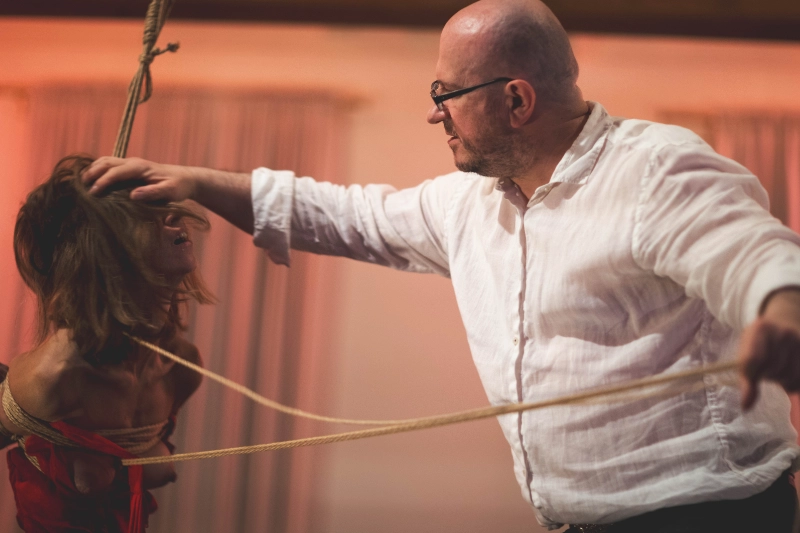
The waist-rope plays an important role in our style. Maybe you can even say that it is one of the essential style elements?
Chest and shoulders as well as the hips, these are the two gravity centres of the body. They are the two pivotal points. Figures in space are created by rotating around and relating these two centres.
Many styles (and non-styles) control the hip with a stable harness. Around this harness the suspensions and transitions take place. Often the hip is much more important as the center of gravity than the shoulders.
Naka-San does not make hip-harnesses. There is at most this very wobbly construction of two loops on the thighs, connected over the bottom: the Naka-panties. We practically never use them. One could say that this extravagance “drove” us into this style: Hip-harnesses were and are “hard limit” for Natasha. Non-negotiable…
So instead we use the waist rope. A waist rope is always also a seme-rope.
A well tied hip harness gives a certain “comfort”. That’s why you can go into various transitions. The hip is held securely.
At the waist, where our inner organs (and our hara) sit unprotected from the cage of the hip bones, it will never feel “comfortable”. At the waist-rope, the people who want to get involved with this style separate themselves from those who don’t want it (which is totally ok).
There are forms, where the hip is „framed“ by connecting the waist to the legs, where a harness is formed based on a waist rope: Half- / or full Monoblock, Mermaid-Harness, or Agura.
In many figures the waist rope is technically not essential: Kata-ashi, Futomomo suspensions, Gyaku-ebi. Still, nevertheless, more often than not, it is there.
It attacks the bottom’s center, showing them how vulnerable they are. It brings them out of balance, presses on sensitive areas, takes their breath. It is a seme-rope.
The waist rope can also become the essential suspension rope in a suspension. Certainly the hip is not as securely enclosed as in a hip harness but at least: you can hang safely in it. Many head over heels suspensions (Sakasa) are based on a well tied waist rope.
In most sessions I tie a waist rope. It is a main element of my semenawa. Because it can be used in so many ways, it is also one of the ropes with which I can take the action in “suspense”, in delay. With a waist rope nothing is decided yet – except that it will be a little more uncomfortable, more challenging in the rope.
And that is what it is all about…