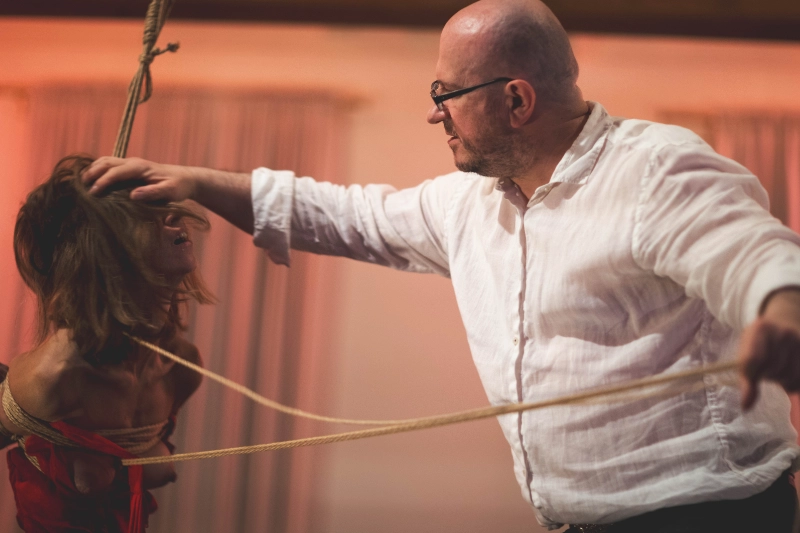
“In most sessions I tie a waist rope. It is a main element of my semenawa.”
ALEXANDER'S LENS
A waist rope is never just a technical rope. It controls the centre of the body, can become the foundation of a suspension and, at the same time, deliberately creates discomfort and vulnerability. In our style of Kinbaku, it is one of the most versatile ropes – and one of the most essential elements of semenawa.
When we practise Kinbaku, what are we actually doing? I believe we need to distinguish three very different modes: exercise, research and session. Exercise is where we repeat what we know. Research is where we take controlled steps into the unknown. Session is where we let go of both and allow something to happen between two people.
Move the hips. Lower the shoulders. Add tension to one foot – and suddenly a completely different figure appears. Kinbaku positions are not isolated shapes but points within a much larger space of possibilities, defined by physics, anatomy and aesthetics. Kata helps us learn to navigate this space. The interesting question is what happens when we begin to move beyond it.
What happens if you start tying without knowing where you want to end? Instead of choosing a position and working towards it, I try to stay in suspense: making one decision, then another, allowing the next step to emerge from intention, intuition and inspiration. Like improvising a jazz piece, the rules and techniques remain – but the final form is not yet known.
A Gote begins before the first rope touches the body. Do you take the arms, does your partner offer them, or do you meet somewhere in between? I see three fundamentally different ways to begin: through martial control, through cooperation or through polarity. The resulting Gote may look similar from the outside, but what happens between the two people can be completely different.
MORE POSTS :