
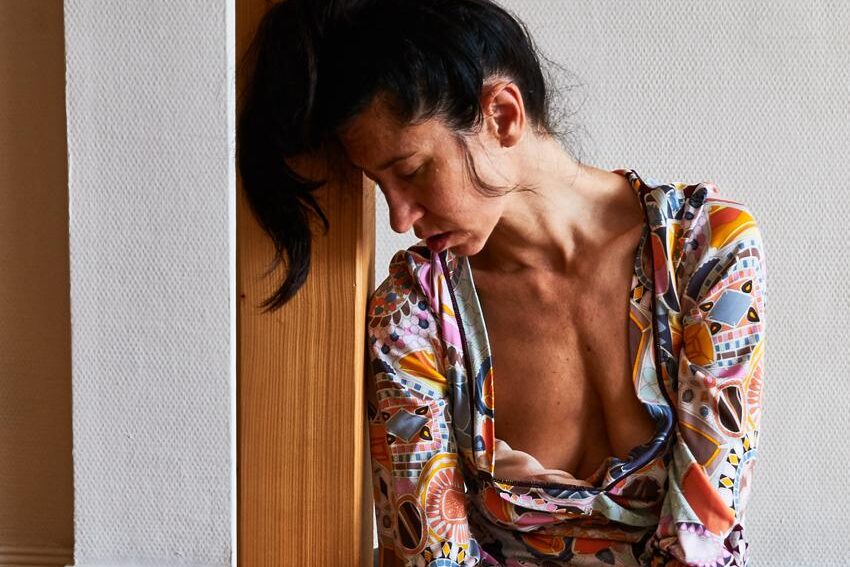
I gave a talk yesterday in Studio Ma about surrender in ropes. As part of the story, I talked about my pattern of resistance, which is something that we call “conditioned tendency” in somatics.
Conditioned tendency (CT) is our habitual self, our behaviour pattern, or attitude that would come out, when we feel under pressure. This pattern we learned a long time ago when it was helpful to solve some conflicts around safety, belonging or dignity… and through being repeated a few times, it became embodied.
There is nothing wrong with having such patterns, except, it limits our capacity to be spontaneous and respond according to the present situation.
This pattern is hard to shake. The teaching is, it’s about learning our pattern intimately, that we find a possibility of change. Awareness brings a choice.
When I know how the habitual resistance feels in my body, when I know I will hold my breath and tense my muscles, I have (at least, a little bit more) choice to not do it.
When I know what my body does to dissociate, I have (at least, a little bit more) choice to not do it. I can take a breath. I can move my body voluntarily. I can do something to break the habitual chain of reaction.
This is the teaching.
But this is not enough.
It is very important to understand why it appeared in the first place. Not even to understand, but to feel it.
It appeared as your body was trying to protect you. To preserve your core. You essence. Your uniqueness. Your personality. Your divinity. That which makes you – you.
This hard part inside of the fruit, what is it called in English? A pit, a stone? We call it a bone in Russian.. “A little bone”, to be precise. It’s a bit of a different interpretation, I think. It’s something that is inside of us, on which everything is built.
This is the place from which we love. From which we create. From which we offer our gifts to the world. We all have it.
So what the body was trying to do at that time is to protect this “little bone”.
And it cannot not do it.
The opposite is – suicide. Feel into it. How life-affirming it is. It wasn’t enough for the body to keep us physically alive. It wants to preserve our individuality, our spirit.
***
The thing is that we mainly get to interact with the inadequate part of our CT. When the habit is inadequate to your current circumstances. Because it is often inadequate, because it got stuck. So we get angry at it. “Why can’t you just… be like everyone else! like all other kids!” – we say to our kids the same way we heard it ourselves as we were kids. Or if we don’t have kids, we keep saying that to ourselves…
But it’s the same “stupid thing” that makes someone fall in love with you. Isn’t it so?
So – love that little bone. It’s your source. And appreciate your CT. It kept you alive.
***
And it’s always our bodies that step in.
Bodies know long before it reaches our consciousness. Before we find a way to deal with the situation, the body is already doing it.
You know, our bodies will never – ever! – give up on us. Suicide is a mental decision. But our bodies will always act in self-preservation. The more I learn about it, the more fascinated I become.
Dissociation, resistance, hiding, shrinking — these patterns are self-preserving. The body will fragment us for the sake of preserving us. This is why we always find healing through our bodies. They will always give us another chance.
I mean, how beautiful is that.
And sometimes people ask me in workshops: so why is it important to feel myself?
Well… where do I start…


