
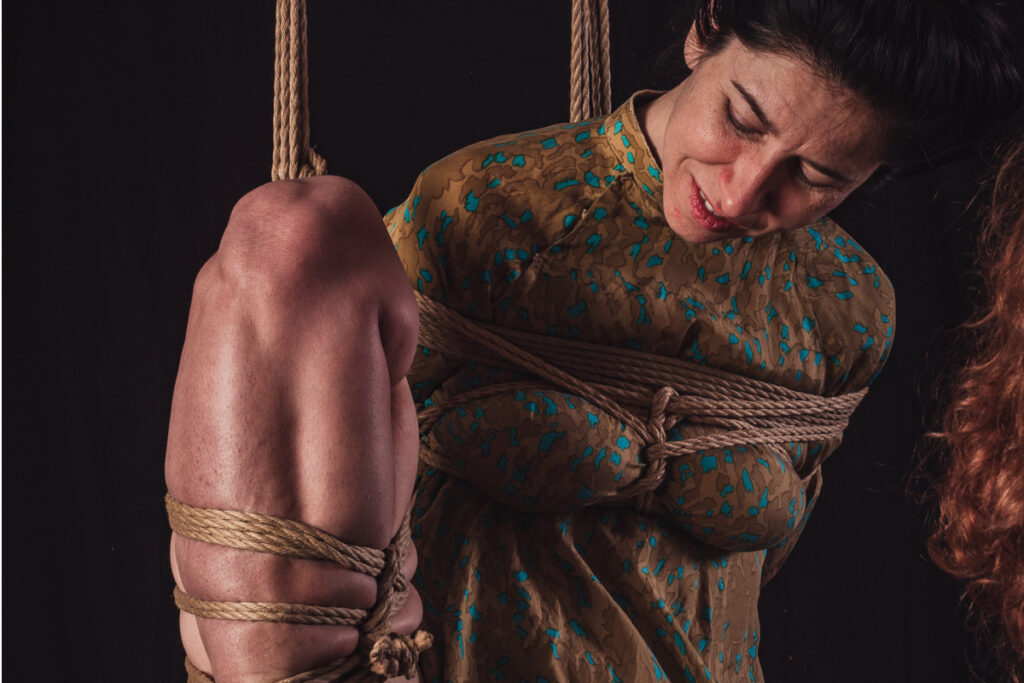
I want to share something from a recent conversation with a friend who is also a very experienced rope bottom. She said now when she is so experienced she struggles sometimes to sink into the ropes… She would know very early when something won’t work – sometimes the moment it’s tied on her, but speaking up in those moments leads to frustration of her partner. However her main motivation is helping him to learn, they would end up in frustration…
She is definitely not alone, I recognize this from my past, I also observe rope couples in the classes coming into this dynamic. I would like to pick it up here and talk about communication in ropes – or how do we communicate when it’s going to be wrong.
Of course I’m being a bit ironic. We don’t know that. But also, we know, as we know our bodies. When we are experinced, we know even better. This impulse is understandable. And yet it mainly leads to tension and giving up on experimenting.
I think there are several topics here and it starts with our feeling of safety.
Feeling in the moment vs. anticipating
At least, this is where I would suggest starting, with asking ourselves: what do we need to feel safe to drop that anticipation habit? What do we need to allow for spontaneity? Maybe we need some confidence that we can feel the issue – when it’s there – in the moment? Maybe we need some confidence that our partner will be able to handle the issue – in the moment?
Anticipation is not a helpful strategy, simply because we are not in the present moment. We put ourselves under a lot of pressure, constantly expecting what comes next: Would they take an ankle? Am I going to end up in the back band? How long are they going to keep me in this suspension?
Instead, try shifting your attention to what you are actually feeling in your body, right now. Notice your breath. Is there any tension? Any sensation, temperature, or movement? Only when we are present with what is truly happening can we notice – and communicate – in the moment if there is a real problem.
This is a necessary fundament for developing a spontaneous play.
There is no letting go without feeling safe first.
Understanding it’s not our responsibility to make anything work
Yes, even if it’s a workshop and you want to help them to complete that shape. First of all, there is nothing to complete, even if you are in the workshop. There is no learning without failing, making mistakes etc but most of all, it simply doesnt work like that.
All you can offer is your presence and your patience – within your limits – and your feedback about how it felt – after the exercise.
This harness moved on my hipbone, I had a hard time coping with the sharp pain.
I feel my blood flow cut off by the cuff.
Or your immediate request upon getting into a safety issue:
I have a nerve problem, let’s untie NOW.
Corrections must be offered by the teacher, in a skill-building class. As a scene we love to go to experience-based classes, but this is again another topic. If necessary, seek skill building instructions to address sloppy ties that feel bad on the body, and in fact our attempts to make it work from the bottom side is counter productive to the learning process.
Learning to express ourselves non-verbally
I really believe that rope offers us an amazing opportunity to shut up 🙂
I am not suggesting to shut up and tolerate, I hope this is clear. But there are so many rich, juicy ways to communicate what is happening to us without words.
Develop your way of expressing yourself according to what feels natural to you, using your voice and your body, breathing, moaning, moving, tensing and relaxing… letting your rigger know when you are close to the limit – or you are having an issue. They would much rather prefer this kind of communication, trust me…
And if they don’t pick it up at first (which can happen, especially in the beginning), you may need to amplify it. Over time, this communication can become more subtle…
Maybe one more thing to add. Especially for the experienced couples. Question the modality, not yourself.
When nothing seems to work, instead of trying harder to make it work, take a pause and listen to your body.
I think it also could be an amazing opportunity to check in with our bodies to understand what is going on on a deeper level and if you still feel the meaning behind what you are learning together.
I think generally we can always benefit from slowing down, questioning our habits and what we assume to be the right way of doing things.
I hope there is something here for you.


