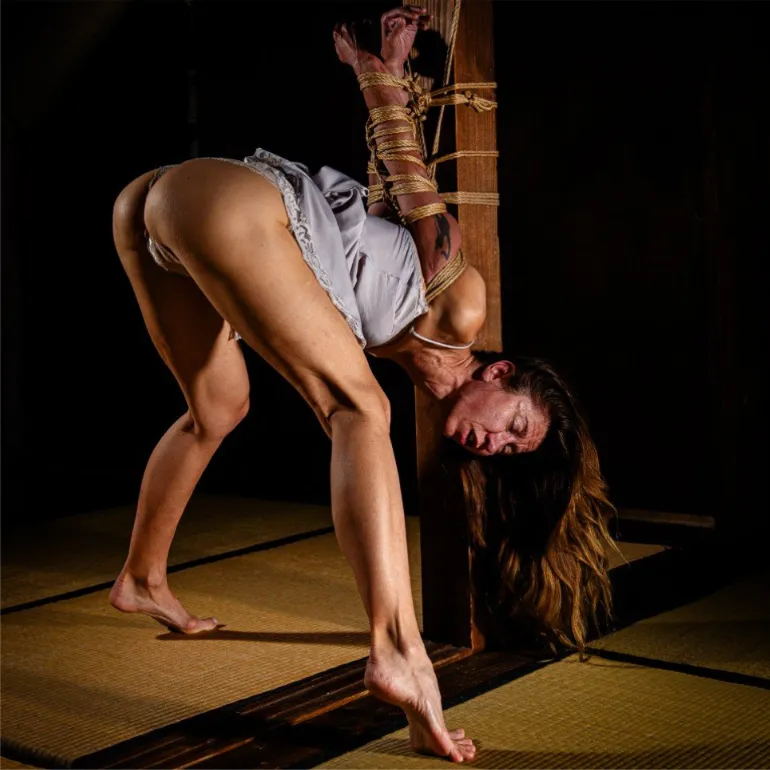

Where to draw the line? It’s a million-dollar question in rope bottoming.
Here is my attempt to answer from 5 years ago: Good Pain vs. Bad Pain – offering a gentle possibility on how one can approach thinking about it. These days, my answers are slightly different, and probably even less concrete.
First of all, this line / boundary is not found once and for all. It’s something we have to discover anew each time, depending on our resilience and resourcefulness in the moment.
It’s about meeting ourselves again and again in the situation of rope / impact play.
To support this process, we need to slow down. Take small steps towards our limits. Listen closely to ourselves.
Ask: What does each step feel like in my body?
Notice: What sensations are there: pressure, temperature, movement…? What is their intensity? Are they changing, becoming sharper, more urgent?
To make it more tangible, here are some examples:
- icy coldness creeping into our fingers and toes
- sudden flush of heat in the face or chest
- rapid trembling of a fatigued muscle
- tingling pins and needles in hands or feet
- rhythmic pounding in the head
- swelling sensation or a numbness of the tissue
- sharp stabbing like a needle
- dull, heavy ache in the joints
- burning sensations
- deep soreness building gradually
- electric tingle racing across nerves
- hollow emptiness in the stomach
- buzzing sound in the ears
- everything else – millions of happenings – we can notice in our bodies when being tied… these are just examples…
We need to memorize these sensations. And when the session ends, and the ropes come off, we need to notice how they change. Next time, when you are tied, you will meet a familiar sensation again. You will know a little more what it means for you, and how urgent it is.
This is the work: learning to feel ourselves.
For some of us, this sensitivity comes easily. It’s a precious gift.
For some, it takes effort and patience to develop this ability. I’m convinced that it is necessary work, if we like to play with impact and go to our limits.
There are no shortcuts in this journey.
The anatomic lectures about nerve pathways and checklists on the internet forums might give you some theoretical knowledge, but they are also misleading. The thing is, that line – the boundary we are searching for – does not become accessible through the knowledge. It must be felt. It’s a wave of ANS activation, it’s our muscle tension, heartbeat and pulse, sweat and breath. It’s our capacity to absorb and integrate, which manifests at a certain limit.
So we must look inward. There is literally nothing outside of your body that will offer you any indication about that capacity of yours.
Safety is not a cognitive concept; it’s felt.
It’s about developing our sixth sense, an intuition.
The more we do that, the more refined our “safety radar” becomes.
Our developed intuition is the greatest gift we have as rope bottoms – and the greatest offering we can bring into our rope partnerships…
***
And if you’d like support in tackling this and other bottoming questions, check out my rope bottoming coaching offer.


