You know, our bodies will never – ever! – give up on us. Suicide is a mental decision. But our bodies will always act in self-preservation. The more I learn about it, the more fascinated I become.

Is that all you can do?

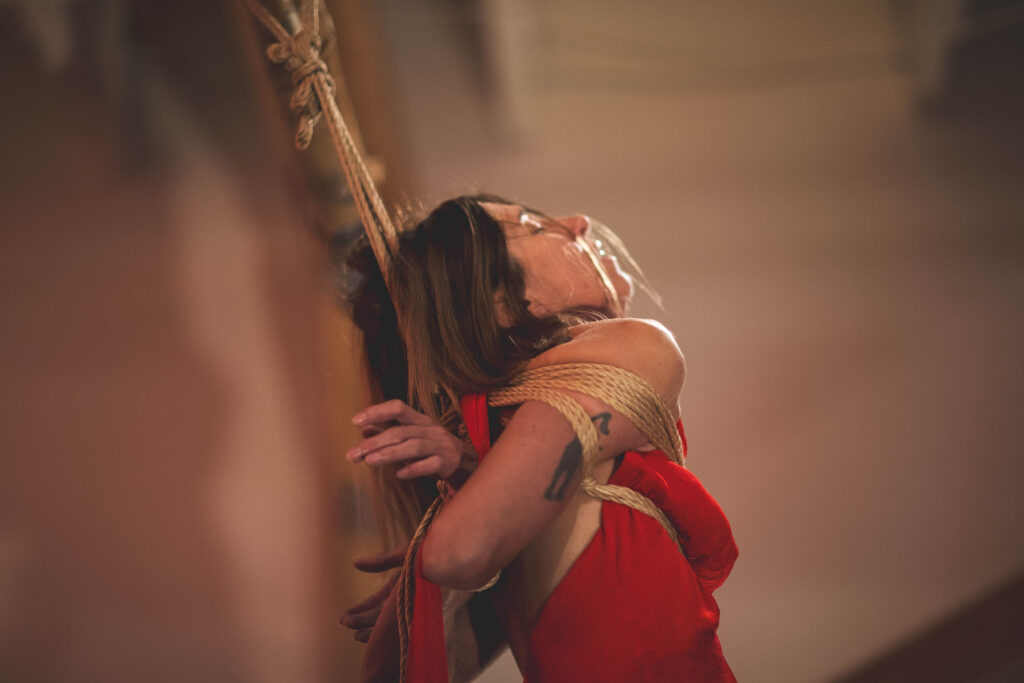
Rope bottom leaning backwards in an upper-body Kinbaku tie
Photo: Brandon Betterrugged

I was asked the other day: “would you like to be tied in other forms than Gote?” After some thinking, I had to answer twofold.

First, I don’t mind being tied into anything. I love being touched and enjoy the feeling of being restricted and impacted and held and and… by my partner. Whatever he chooses to do to me, I can enjoy that. 

But also, I would dont mind being tied only into Gote till the rest of my life. Because there is so much in it. Because it’s different every time anyway. Because it’s not about the form… Because there is no form, but only our perception of it. 

Obviously, both answers say the same. Which brings me to the other point. 

When we ask rope bottoms at workshops for feedback, sometimes we hear: “Well, it was not so hard / challenging…” Said with this slightly questioning intonation, meaning: “…they didn’t mess it up completely, but there was potential for so much more”. 

When we catch ourselves thinking like that, we really have to stop and reflect: 

What is this “is that all you can do” mindset? 

Why this constant hunger for grandiosity and novelty? 

I really think we can do better than transmitting a feeling of disappointment to our partner. 

We can live our own story in rope, no matter how simple the tie is. All we need to do is to lower our expectations and open up ourselves to feel. And this is our practice. 

We can have a very different emotional experience even if we have been tied in the same thing a hundred times. All we need to do is to anticipate less and start appreciating the nuances of what is there in the moment between us and our partner. 

And this, too, is our practice.

MORE POSTS

The stubborn “little bone”

We all have a stubborn “little bone” inside us – something our bodies learned to protect a long time ago. In somatics, we speak about conditioned tendencies: patterns of resistance, dissociation, shrinking or fighting that appear when we feel under pressure. They may limit us today, but perhaps before trying to get rid of them, we should understand what they were protecting. That stubborn little thing might also be the place from which we love, create and remain unmistakably ourselves.

When it’s going to be wrong…

The more experienced we become in ropes, the earlier we sometimes know: this is not going to work. But what happens when that knowledge gets in the way of the experience itself? When anticipation replaces feeling, corrections replace communication, and both partners end up frustrated? Perhaps the practice is not to know less, but to trust ourselves enough to stay with what is actually happening – until there is something real to respond to.

You don’t need to be “educated” to enjoy ropes

A newbie rope bottom told me that a rigger had stopped tying them because they were “not educated enough”. That sentence stayed with me. When did we start believing that we need an education before we are allowed to experience our own bodies? There is much we can learn in ropes – but perhaps we should be careful not to let knowledge replace something we already carry: our capacity to feel, respond, enjoy and say no.

CHAT WITH

Somatics for

Rope Bottoms

Natasha’s exploration of embodiment, consent and the experience of being in ropes.

Coaching for
rope bottoms

Coaching for rope bottoms

Learn to trust your body’s wisdom and discover your own way of being in rope.