
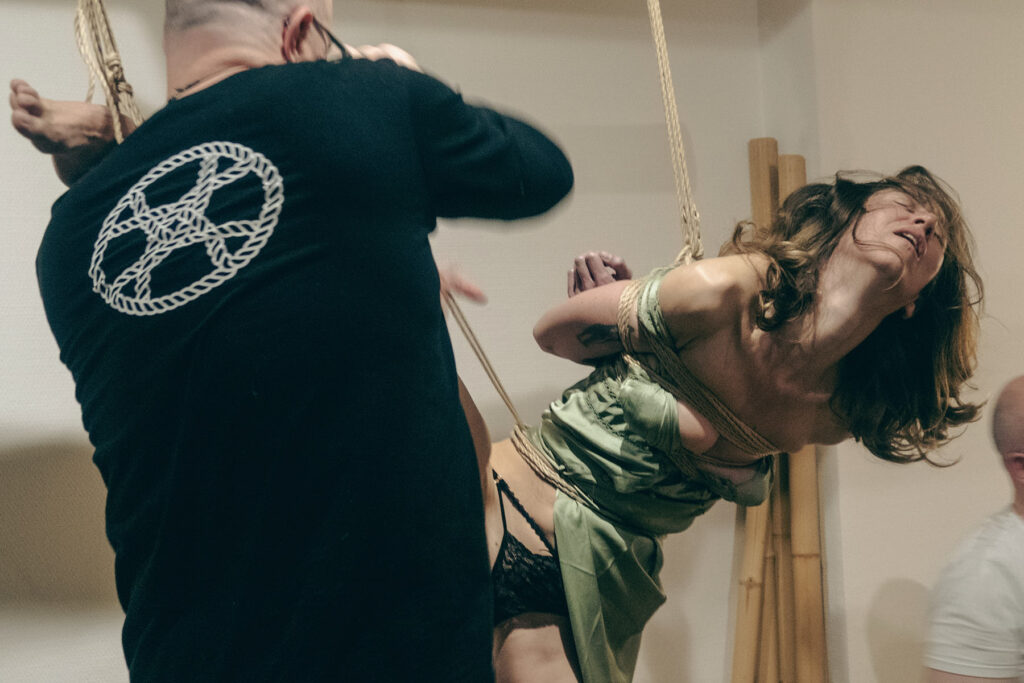
When I think about the movement, what it is and what it brings into the Kinbaku session, I think first of all about the communicative aspect of it.
What I mean is, when we allow for a movement, we transition from tying the object to tying a subject. We invite them to have a will, and to express themselves. We invite a dialogue.
This is not everyones goal. This week in the class, the student exclaimed “Viel zu frei!” (somenting like “way too free!” in English) about the movement of their model. It’s a different psychology of the session which stunned me at first but then I really appreciated the clarity.
DS is a powerful game. I wrote about the differences in these two approaches before: Tying as Inquiry vs. an Imposition, but then now it made me realise that these two different games stem from the same assumption: there is a movement to start with… Movement that originates in the body. Movement that is our birthright. Movement that is an inherent expression of the body. Then these two approaches derive into the restraining // objectification // dehumanizing through taking away the freedom of the movement. Or into animating // dignification// humanization through creating an extremely large container to express oneself and indulging into our search for authenticity…
They are different pathways. But the fact that they do share the initial assumption, made me really appreciate DS for the first time. Like, there are different ways to make love.
So when we do want to facilitate a dialogue with the model (and follow a second pathway), here are some hints for the riggers:
- Offering a slack is the way to go. When pulling the tension lines to the extreme, you are leaving no space for expression
- There are actions that block the movement vs. facilitate the movement
- Slowness is your friend. Many rope bottoms need a lot of encouragement and invitations before they “make a move”
- Be honest in your own movements. We feel the difference between the authentic impulse and learned “moves”. Yes, it’s scary, you need to deal with it
- By definition, the container is limited – in time and space. It will be filled with your own movements, your intention, your brightness… or ours. The more you fill it, the less there is free space
- Ambition is your enemy. When you are determined to complete a beautiful shape, that’s what you will get at the end
- Ask your model if they feel seen…
And of course: watch. Observe. Contemplate. Pay attention.
We are lazy with our attention. We are so used to big movements (true for both sides of the rope). It takes time, skills, practice to learn to restrain ourselves, to go deeper, subtle, more nuanced. It takes sensitization and some.. satiation, is it? opposite of neediness) to arrive at the somatic possibility when we can rest inward, and allow things to unfold.
So much practice to do. Movement can show us the way.
TBC next week about the bottoms’ side and how we use movement in different ways.


