
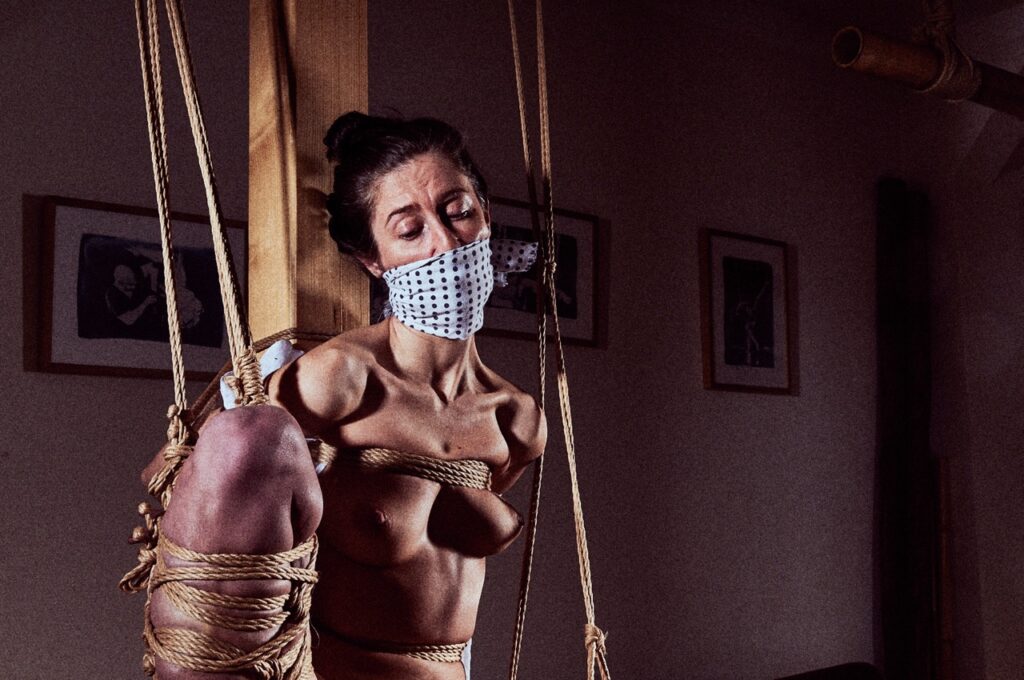
This week in class, there was a discussion about futomomo / tibia pain. It’s a big one. Some of us hate it. Some of us cannot live without it 🙂 I have been asked how I deal with the pain… Here are some ideas.
First of all, confidence that this pain is not going to harm us or lead to injury has a huge influence on how we feel about the pain. Check out the “Good pain vs. bad pain” article (it’s also part of my book “Somatics for rope bottoms”).
Mindset
Our mindset — the meaning we give to experiences like pain — plays a major role in how we process it.
I try to embrace this pain and any other intense non-dangerous pain as a part of the story. Of the choreography of the session. It is like in life… we don’t get to skip the boring parts, difficult parts, painful parts, do we? It is all “data,” and they all teach us something.
I let the pain be, I let it run through my body, crying if I need to. I embrace it, rather than fight it. Resisting it turns out to be always more painful. Eventually, we will tap out and not see the rest of the movie 🙂
Softening
On a physical level, I’m softening.
It is a counterintuitive reaction, and this is just really something we can learn, open the access to. What I mean by softening is dissolving the secondary tensions that happen in our bodies automatically when we are in pain. Shoulders, neck, face, jaw, belly… wherever you are holding it and fighting it – letting it relax. Breathing out the contraction. Softening into the intense sensation.
Softening – leaning into our edge – is a brave act. It will make it easier, I promise. You will immediately feel more space and dignity.
Arousal
Pain is energy. A very high-intensity energy. Holding it down creates more trouble in our systems than letting it run through. So let this rush hit you, warm you up, increase your arousal level…
Some people are very good at converting pain into pleasure. I’m not one of them, unfortunately. I don’t know if this is something one can learn when it isn’t there naturally. I wish I could. For me, it mostly remains pain.
Still, I do appreciate the high that comes from the release of hormones, and sometimes I can feel a spark of possibility, moments where pain really does serve as a portal to something else.
Attention
Attention is a powerful tool. We can shift our attention between this and another body part. More often, I choose to go into my emotional flow. Feel my heart filling and expanding with gratitude. Feeling love for all there is… Feeling kindness. Feeling my offering.
I think lastly there is also something about permission to feel the pain. Admitting that yes, it hurts, and it’s ok to hurt. Which brings me back to embracing and softening into it.
As you see, I don’t have any tricks. It’s more that I have a lot of self-trust that my body will find a way to cope with the challenge. It normally does.
In general, I think it’s the same as any other pain in life. What do we do? We will feel it inevitably and take time to feel it and grieve, we find a way to soothe and come back to life…


