
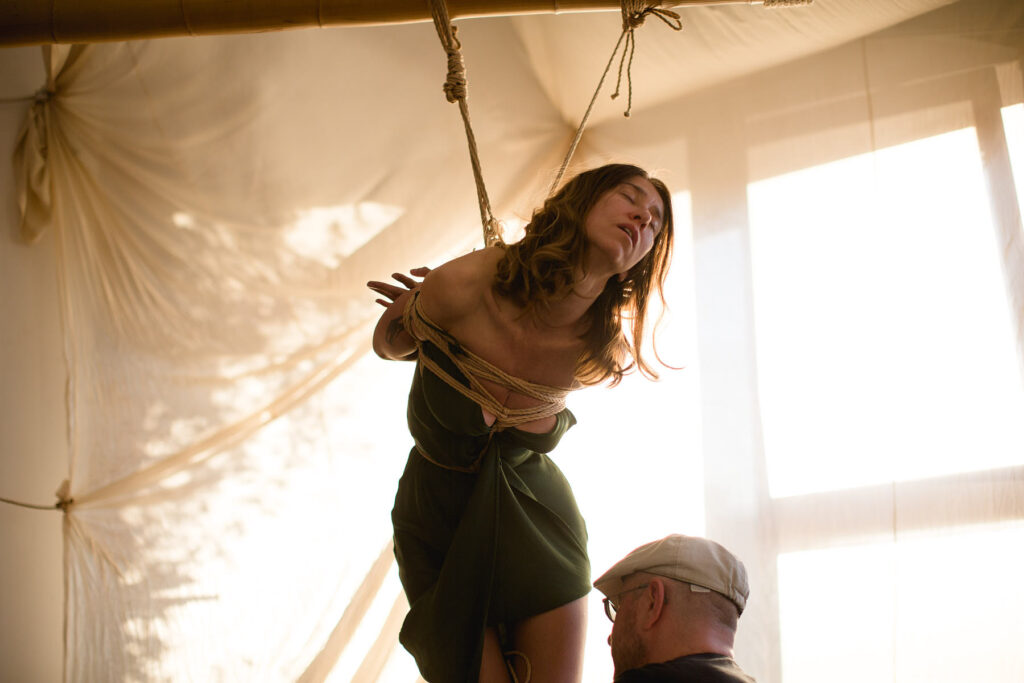
Photo: ArtbyLeelaThe other week, my partner said he could teach other workshops with other models, but not the “Bodies under pressure”. I think it was not just “sweet talk,” but there is something to that beyond it being just an advanced-level workshop.
We both have a message about tying in the moment, something that is very dear to our hearts. Tying not with the end figure in mind, but tying as a somatic dialog between partners, celebrating the moment, playing and testing limits, seeking resonance…
Today I want to speak about our role, the role of a rope bottom, in this process. I want to speak about an invitation.
Surrender is not a passive state. You are the vessel. You are the one making an offering. You are inviting your partner to take that much from you, to bring you that far. To your limits, when you wish…
When talking about this in class, some of the students said, “It’s difficult”. Yes, it is difficult. It’s also difficult for your partner to tie “in the darkness”. To do something the teacher showed and hope it will be all right, hope you will be ok, hope you still enjoy yourself. They care about you, and more than anything else, they are afraid to hurt you…
When you want to play with intensity, play on the edge, go to the limits, you need to show up in the process and find a way – your personal, authentic way – to express yourself. Make it possible for your partner to see you, to read you, to relate to your experience, and through that, invite them to take what you want them to take from you…
Resonance in ropes is a magical thing. But it doesn’t work that the others bring it all to us. Oftentimes, it takes some learning from our side of the ropes.
We need to be intimate with our inner feeling of safety, which we can use as our anchor, helping us to navigate during the session to feel when it’s safe and when it’s not safe anymore. If this is something not natural for us, we might need to do some learning there.
We need to be confident in feeling ourselves in the moment, so we can trust and let ourselves enjoy the experience without worrying and anticipating.
We might need to learn to express ourselves in a way that is authentic to us. It’s very common to have inhibitions about letting out a sigh or making a body movement. This is also something we can learn and get more confident in over time…
Also, ask your partner if they can feel where you are and your state during your rope sessions. You might be surprised by their answers and gain insights into how to facilitate more intensity and connection from your side of the ropes.
I encourage you to practice making intentional invitations during your rope sessions. This will help foster a deeper connection and co-create meaningful resonance with your partner.


